The Unlikely Alliance: Why Arc’teryx and Decathlon Are Teaming Up to Change How We Buy (and Fix) Our Gear
Hey everyone, Charlotte Parker here! If you’ve been following my blog, you know my obsession with Arc’teryx runs deep. From unboxing the newest Alpha SVs to constantly refreshing my tabs to find the absolute best arcteryx sale for you guys, I live and breathe this brand. But today, I want to talk about something different—what happens when our favorite luxury gear gets a tear or a broken zipper.
I just came across some wild industry news that I had to share. French sporting goods giant Decathlon and our beloved Arc’teryx have formed a super rare alliance. They are jointly petitioning the Canadian government for tax breaks on secondhand gear sales and repair services. Personally, I found this fascinating. Right now, repairing a $200 jacket gets hit with the full GST/HST tax (7-15%), adding an extra $14-$30 just to get it fixed.
📌 Why This Alliance Blew My Mind
In my experience covering the outdoor industry, you almost never see brands from opposite ends of the spectrum working together. You have Decathlon, the king of budget-friendly gear (average order value around $45), shaking hands with Arc’teryx, the pinnacle of outdoor luxury (average order $400+). According to the official petition, if these tax reforms pass, it could save Canadian consumers roughly $42 million CAD annually in repair-related taxes alone!
🔑 My Core Takeaways
- The Unfair Tax Gap: Currently, repair services are taxed at the 7-15% provincial retail rate, while standard goods might only hit the 5% GST mark. We are literally being penalized for fixing things.
- Massive Consumer Savings: That $42 million CAD annual savings estimate is huge for the everyday adventurer.
- A Historic Partnership: Decathlon brings the “mass market” volume, while Arc’teryx brings the “technical luxury” prestige. Together, they make an undeniable lobbying force.
- The 2026 Window: Canada’s 2026 federal budget has explicitly listed “extending product lifespans” as a priority, making this the perfect time to strike.
🔍 The Bigger Picture: Europe is Beating Us
Let’s be honest, North America is lagging behind. Europe has already laid down the law on the circular economy. The EU’s “Right to Repair” directive (effective 2024) forces brands to supply spare parts for up to 7 years. Over in the UK, they are slapping a unified, low 5% VAT on repairs and secondhand goods starting April 2025.
I’ve been tracking the global secondhand outdoor gear market, and according to McKinsey’s 2025 report, it’s already a $21 billion industry, growing at 34% year-over-year. That crushes the 3-5% growth of brand-new gear. Decathlon is already testing secondhand sales in Europe via Vintand, and Arc’teryx’s Worn Wear program refurbished over 120,000 items in 2025. This lobbying effort is clearly them paving the runway for their massive secondhand ambitions.
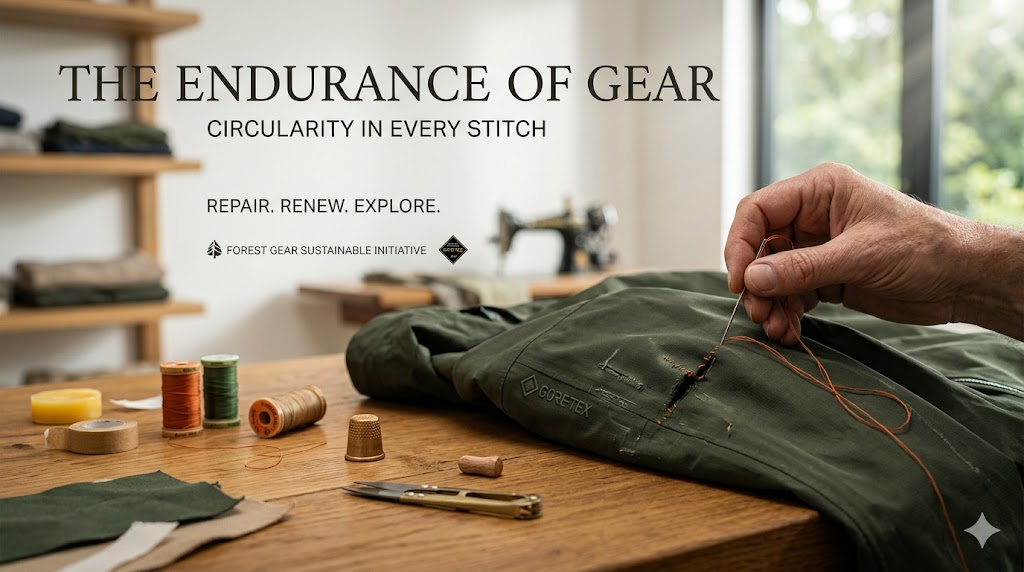
Image source: Official Brand Press Release / Sustainability Campaign
📊 My Industry Insights & Predictions
- The Eco-Premium Shift: A 2025 PwC survey showed that 68% of Millennials and Gen Z actively look at “repairability” before buying. I see this all the time in my comments section!
- A Symbiotic Alliance: Decathlon needs Arc’teryx for technical credibility in the boardroom; Arc’teryx needs Decathlon to prove this impacts everyday people, not just the wealthy. It’s brilliant.
- The Quality Control Squeeze: If repairs become cheaper and more common, brands will be forced to build tougher gear to avoid overwhelming their own repair centers. It’s a massive stress test for Arc’teryx’s “built to last” promise.
- Who Controls the Prices? Once secondhand markets are fully legitimized and cheap to use, brands lose grip on their pricing power. You can bet I’ll be tracking these secondhand drops closely on my Sales Calendar!
💼 How This Actually Impacts the Business
📈 Trend Predictions: Where Do We Go From Here?
Short-term (3-6 months): Expect closed-door discussions with Canada’s Ministry of Environment. By late 2026, we might see initial pilot programs in provinces like Ontario or Quebec.
Mid-term (6-18 months): If it works in Canada, this will absolutely spill over into the US. The Biden administration’s Build Back Better framework already touches on repair tax cuts. Brands will use Canada as the blueprint for all of North America.
Long-term (18+ months): I firmly believe we are moving toward a “Product-as-a-Service” model. Soon, you won’t just buy a jacket; you’ll buy the “right to use it + guaranteed maintenance + recycling promise.” It’s going to completely rewrite how I review gear for you guys.
🌐 What This Means for YOU
The Target User: My typical reader—eco-conscious outdoor lovers, aged 25-50, who appreciate premium gear and don’t mind paying a slight premium for sustainability.
The Scenario: Your favorite Arc’teryx softshell has a torn hem after 3 years. Instead of tossing it and spending $400 on a new one, this tax cut saves you up to $30 on the repair bill, making fixing it a total no-brainer.
The Solution: You drop it off at an Arc’teryx Gear Loop center, pay a much more reasonable, tax-free fee, and extend the life of your beloved jacket for another 5 years. It’s a win-win.
❓ FAQs (From My DMs)
Q: When is this actually happening?
A: Right now, it’s just a petition. The best window for approval is during the 2026 Canadian fiscal budget reviews. Realistically, we might see pilot programs late 2026, with a full rollout in 2027.
Q: How do we know the secondhand gear is actually good quality?
A: According to the drafts I’ve read, the tax break will only apply to brand-certified gear or items with third-party inspection tags (like ISO 14021). So no, they won’t be subsidizing junk!
Q: Will this impact us in the US or other countries?
A: It starts in Canada, but the ripple effect will be huge. Europe already dropped their tax to 5% in 2024. If North America proves it works here, it’s only a matter of time before it becomes the global standard.